MVVM Architecture
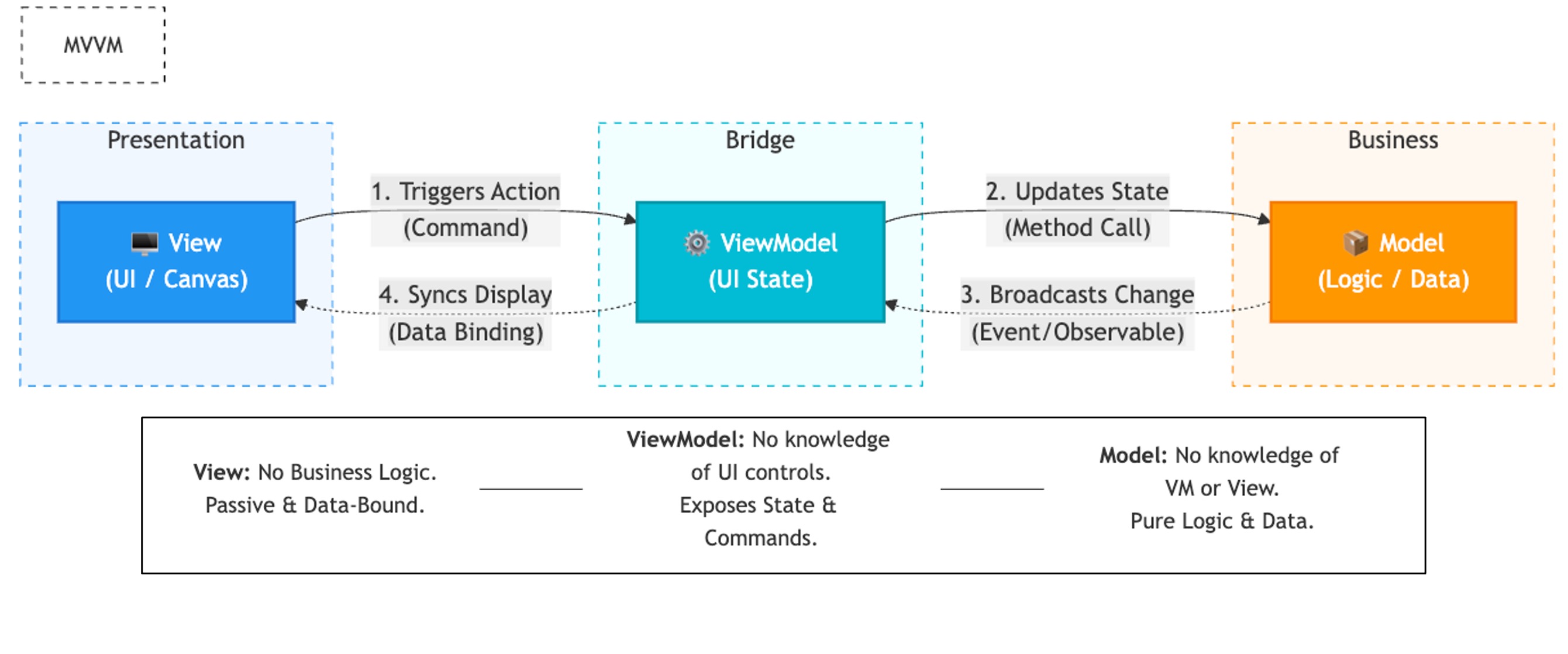
MVVM: Model-View-ViewModel
MVVM (Model-View-ViewModel) is a way to build UIs where the View is reactive and simple, the ViewModel translates user intent into state, and the Model holds your core domain data and rules. As per wikipedia, it is a layer architecture that faciliates the separation of the GUI and the development of the business / backend logic, so that the view is not dependent on any specific model.
The Intuition
MVVM is a translation layer between two worlds. The Model speaks in domain terms, the View speaks in pixels and controls, and the ViewModel interprets between them. That separation makes change cheaper: redesigning the UI does not rewrite the rules, and changing rules does not require new UI code.
What MVVM Is (And Is Not)
The Model owns domain data and rules and should not know about UI or how it is displayed. The View owns rendering and input handling but should not contain business rules. The ViewModel owns UI state and UI logic derived from the Model and exposed for binding.
A common correction: the Model does not update the ViewModel directly. The ViewModel observes or recomputes from the Model and publishes derived UI state. The Model should not depend on the ViewModel.
Where MVVM Is Commonly Used:
MVVM is popular anywhere data binding is strong. It is common in SwiftUI with @StateObject and @Published, in Android Jetpack with ViewModel plus LiveData or StateFlow, and in WPF/UWP with INotifyPropertyChanged. The pattern fits best when the UI can be expressed as a function of state.
- Typical flow: the user interacts with the View, the View calls a method on the ViewModel, the ViewModel updates the Model (or a copy of it), and the ViewModel publishes new UI state that the View renders. The key rule is: View knows ViewModel, ViewModel knows Model, Model knows nobody.
Folder and Code Organization:
Folders are a tooling choice, but a clean layout helps. Some teams group by layer (Models/, ViewModels/, Views/, Services/). Others group by feature to keep related pieces together. The structure matters less than preserving the responsibilities.
Common Pitfalls
MVVM breaks down when you overload the ViewModel with business rules, duplicate state in multiple places, or rely on two-way bindings everywhere. Keep domain rules in the Model or domain services, compute derived UI state instead of storing it twice, and use bindings only for local UI concerns.
Another common mistake is letting the Model depend on UI types. If the domain has to be reusable or testable without UI frameworks, keep UI types at the edges or wrap them in domain-friendly types.
Alternatives (And Why MVVM Is Often Chosen)
MVC can balloon in the Controller, and MVP can grow a Presenter that orchestrates everything. MVVM usually stays lighter because the View reacts to state changes instead of being directly driven. It is also easier to test: the Model and ViewModel can be exercised without rendering the UI.
Other Patterns: MVC: The Controller handles user input and updates the Model and View. Good for simple apps, but Controllers often become large and hard to test.
MVP: The Presenter owns presentation logic and pushes updates to the View via an interface. This improves testability, but the Presenter can become a central bottleneck.
MVVM: The ViewModel exposes bindable state and the View reacts to it. This fits reactive UI frameworks and keeps UI orchestration lighter.
In short: MVC and MVP are more imperative (the middle layer pushes the View), while MVVM is more declarative (the View reacts to state).
Overall
MVVM is not just a folder structure. It is a separation of responsibilities: Models express what is true in your domain, ViewModels express what the UI needs to show and do, and Views express how it looks and reacts. Keep those roles clean and your UI becomes easier to evolve, test, and reason about.